Customer vs. Utility Piping Boundary in Virginia
A common point of confusion for Ashburn homeowners during a gas emergency is determining who is responsible for repairing the leak. Under Virginia State Corporation Commission (SCC) regulations and local utility tariffs, Washington Gas and Columbia Gas of Virginia are only responsible for infrastructure up to the meter outlet.
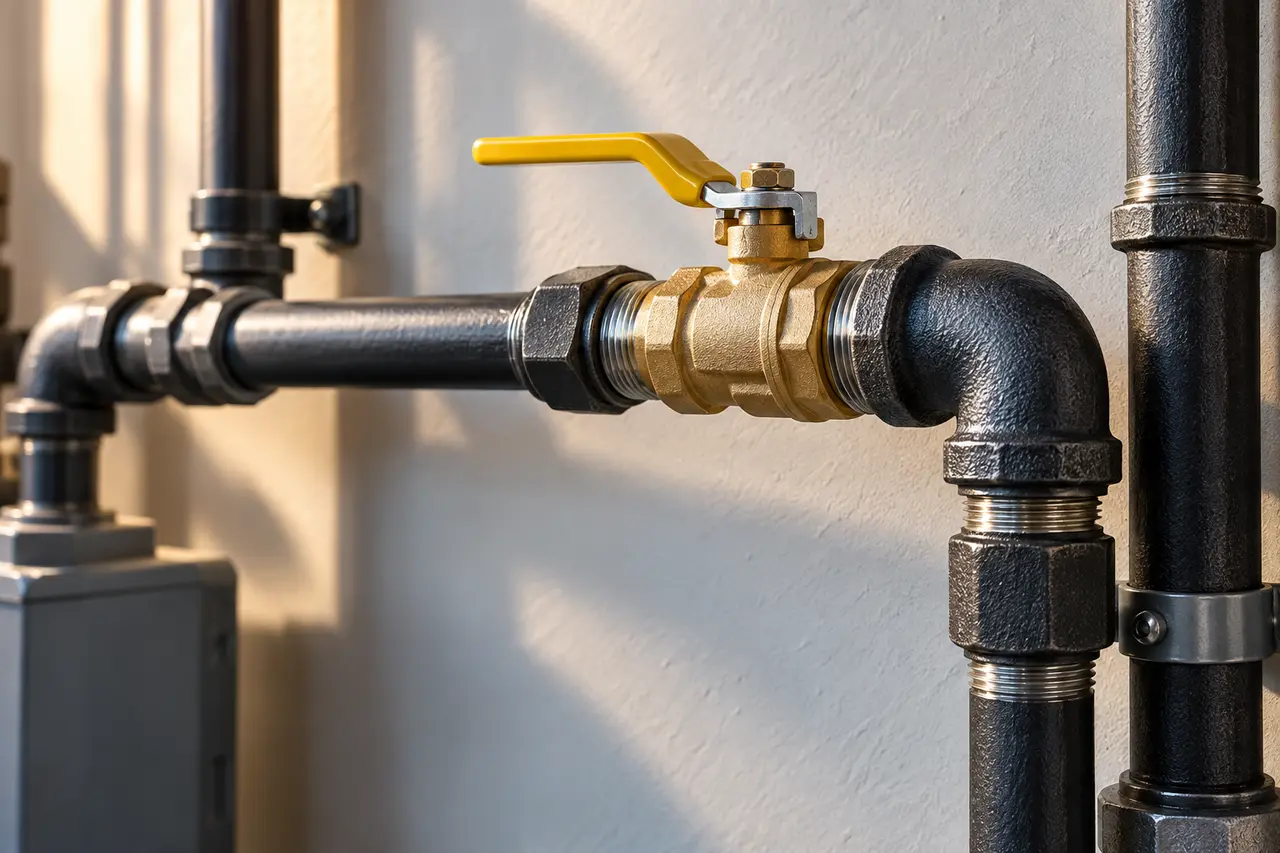
This means the underground distribution main beneath your street, the service lateral entering your property, the pressure regulator, and the gas meter itself are utility property. However, the brass or black iron fitting exiting the meter, the pipe entering your foundation wall, and all internal piping servicing your furnace, water heater, kitchen range, and fireplace are entirely the customer's property.
When utility emergency technicians respond to a suspected gas odor and detect leakage downstream of the meter outlet, their safety mandate requires them to turn off the service valve and padlock the meter or attach an official red warning tag. They cannot perform repairs on customer-side piping. The homeowner must hire a licensed master gas fitter to locate the defect, make code-certified repairs, and provide testing documentation before the utility will unlock the supply.
Black Iron Schedule 40 vs. CSST Flexible Piping
Residential homes in Ashburn feature two primary types of natural gas fuel piping: traditional threaded Schedule 40 black steel pipe and Corrugated Stainless Steel Tubing (CSST).
Threaded Black Iron (Standard in 1980s–1990s Builds)
Black iron pipe utilizes National Pipe Taper (NPT) threaded connections sealed with pipe thread sealant (dope) or specialized yellow gas-rated PTFE tape. Over decades, thermal cycling from seasonal temperature changes in unconditioned basements and building settlement can cause microscopic voids to develop within threaded joints. These leaks often present as faint sulfur odors that fluctuate with weather.
Corrugated Stainless Steel Tubing (CSST)
Popular in homes built from the late 1990s through today across Broadlands, Belmont, and newer Ashburn developments, yellow-jacketed CSST allows flexible continuous runs from a central manifold to appliances without in-wall threaded joints. However, CSST has critical vulnerabilities: it is susceptible to puncture from drywall screws and electrical arcing from nearby indirect lightning strikes.
Corrugated Stainless Steel Tubing (CSST) & Electrical Bonding
Schematic showing flexible yellow CSST pipe, mechanical brass fitting, and mandatory 6 AWG electrical ground bonding.
Under Virginia Fuel Gas Code § 310.2, all yellow CSST systems must be directly bonded to the electrical service grounding electrode system using a minimum 6 AWG solid copper wire and an approved brass bonding clamp. Our technicians inspect and verify bonding on every repair call.
The 15–30 PSI Air Pressure Testing Procedure
You cannot verify the integrity of a natural gas system using utility gas pressure alone. Operating residential natural gas pressure is remarkably low—typically only 0.25 to 0.5 pounds per square inch (7 to 14 inches of water column). A tiny joint leak might weep undetectable amounts of gas at 0.25 psi while still posing long-term hazards.
To certify a system after repairs, our master gas fitters perform a rigorous pneumatic air test:
- Appliance Isolation: Every appliance shutoff valve is closed to protect sensitive gas control valves (which are rated for a maximum of 0.5 psi) from damage.
- System Pressurization: The gas lines are charged with dry air or inert nitrogen to between 15 and 30 PSI—over 30 times standard operating pressure.
- Dwyer Gauge Monitoring: A calibrated test gauge with 0.1-psi increments is installed on the manifold. The pressure must hold completely steady with zero drop over a minimum duration of 15 to 30 minutes.
- Bubble Verification: If pressure drops, all accessible fittings are coated with non-corrosive bubbling indicator solution while electronic sniffers probe wall cavities.
Loudoun County Building & Development Permitting
Gas piping repairs must adhere to the Virginia Uniform Statewide Building Code (VUSBC). The Loudoun County Department of Building & Development requires mechanical or plumbing trade permits when replacing more than 6 feet of gas piping, adding new appliance branch lines, or altering central manifolds.
As licensed Virginia Class A contractors, we handle all permit filings, schedule county inspector visits, and provide the certified pressure test affidavits required by Washington Gas before meter unlock.
Interactive Repair Cost Estimator
Calculate typical costs for your gas line repair based on property type and scope:
Loudoun County Gas Repair Cost Estimator
Estimate typical residential repair and replacement costs across Ashburn and Loudoun County based on scope and home architecture.
Need Immediate Emergency Gas Help? If you smell gas inside your home right now, evacuate immediately and call 911 from outdoors. Do not use electrical switches. Once responders clear the property, call us at (703) 312-2655 to schedule diagnostic pressure testing.